Procurement people love clear answers. We want to compare two options, sort by price, and move on to the next problem. Bearings don't cooperate with that approach. And when they don't, it gets expensive.
The question that sounds clearest at almost every bearing review is: Which is better, ball bearing or roller bearing? It looks like a reasonable comparison. It's also the wrong first question.
The question I started with
When I first started buying bearings, I assumed a bearing with the same bore, outside diameter, and width was close enough. I treated the bearing type as a minor detail. If a supplier quoted a ball bearing where the original machine had a roller bearing, I compared the price and saw a saving.
In Q2 2024, I approved that kind of substitution. The replacement had the same boundary dimensions, cost about 18% less, and went into the machine without any visible installation problem. It failed after about two months. The original component was expected to run for years. When I reviewed the real cost in our tracking system, the total was much higher than the purchase price: replacement bearing, second change-out labor, inspection hours, and production loss.
That was my lesson. I told our team that if we can't answer why this type? before which price?, we're not buying a bearing. We're betting on one. And I don't like betting with the maintenance budget.
The difference between ball and roller isn't as simple as stronger vs faster
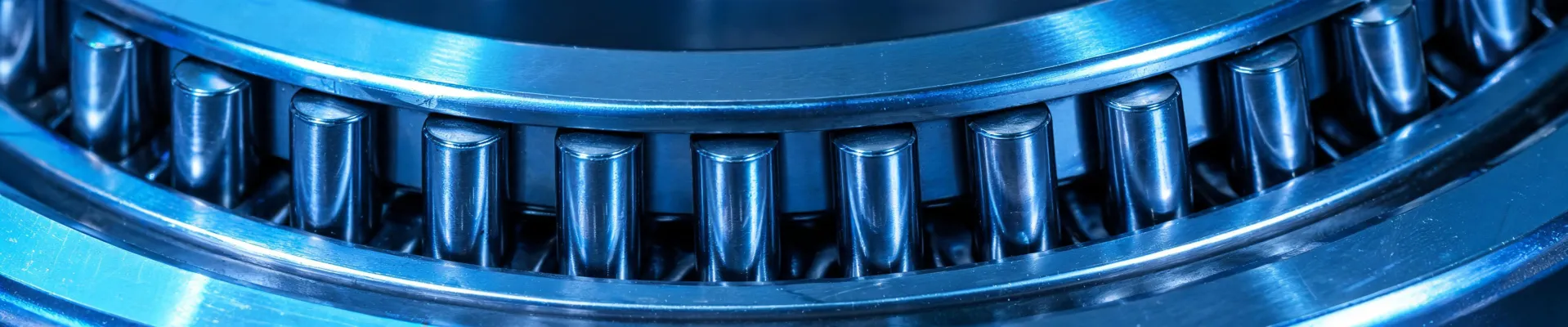
Mechanically, the difference is contact. A ball bearing contacts the raceway at roughly a point. A roller bearing contacts the raceway along a line. Point contact gives low friction and supports moderate radial and axial loads at higher speeds. Line contact spreads the load over a larger area, so roller bearings can handle heavier radial loads, but they generate more friction and usually won't run at the same speeds.
Needle bearings are the compact form of line contact. Their long, thin rollers fit into small radial spaces. That's why INA needle bearings show up in gearboxes, cam mechanisms, and pump assemblies where a ball bearing won't fit or won't carry the same radial load in the available envelope. FAG ball bearings, on the other hand, are often the first choice for electric motors and fans because of their low friction and speed capability. But first choice is not always the right choice.
If you run a 10,000 rpm electric motor, a ball bearing is usually right. If that same shaft carries a heavy radial load and has a short mounting space, a roller or needle arrangement may be better. There is no global winner. The winner changes every time the load, speed, alignment, lubrication, or duty cycle changes.
The deeper reason bearing purchases go wrong
Here's what I don't see in a lot of formula-based articles: the decision often goes wrong before anyone says ball or roller. The actual operating load is never written down.
I can ask a supplier for a bearing with the same dimensions, but if no one can tell me the real radial load, axial load, speed, temperature, and expected misalignment, every choice is a catalog guess. I'm not an engineer, so I don't pretend to run those calculations from scratch. But I've learned enough to know when those calculations are missing.
Somewhere in every legitimate bearing selection there should be a documented rating basis: dynamic load rating, static load rating, and a calculated life under the operating conditions. Standards like ISO 76 and ISO 281 define those rating methods. A quote without that context is not a quote. It's a placeholder.
The anti-intuitive part is this: more part-number knowledge usually doesn't fix the problem. If the system doesn't know the load, the bearing choice is still a guess. I've seen buyers switch from an INA bearing to a lower-priced catalog substitute because the dimensions matched. The bearing was fine as a component. It was wrong as a system.
The cost that doesn't appear on the invoice
Bearings are not commodities you buy by weight. Their real cost is measured in operating hours and planned maintenance intervals.
A lower-priced bearing can be the most expensive option if it fails between planned stops. When that happens, you don't just replace the bearing. You pay for overnight freight, overtime labor, and production downtime while the line is silent. In 2023, I compared our emergency bearing purchases against planned ones. Emergency freight and after-hours labor alone added about 35% to the bearing price before we counted a single minute of lost production.
The same logic applies to a t-slot roller bearing on an aluminum extrusion carriage. It may look like a simple wheel, but the load path includes rail hardness, groove tolerances, mounting bolt pattern, and the weight of the moving structure. A bearing block cannot fix a rail that deflects too much. That's also why INA linear bearings require a hard, accurately machined shaft. The shaft condition and alignment decide service life just as much as the bearing block does.
If you compare two bearings by unit price alone, you're ignoring the difference between planned maintenance and emergency response. In our plant, switching the comparison from purchase price to cost per operating hour changed almost every purchasing decision we made.
What I check before approving a bearing order
I don't approve bearing substitutions without four things on the table now. They don't guarantee a perfect decision, but they stop the most expensive mistakes.
- The original machine specification. If the OEM specified a bearing type, changing from a roller bearing to a ball bearing is an engineering change, not a procurement shortcut.
- Operating load and speed data. Somebody has to state the radial load, axial load, speed, and operating profile. Without this, the supplier can't calculate life.
- Rating basis. I ask for the dynamic load rating, static load rating, and calculated bearing life using the actual application data, not just the part dimensions.
- Total cost of ownership. Unit price is one line. Expected service life, replacement cost, and downtime cost belong on the same spreadsheet.
These checks sound boring. They've saved us more money than any discount negotiation I've run.
So which is better? The honest answer
After all that, you probably want a direct answer. Here it is: it depends. I know that phrase sounds unsatisfying, but it's the truth.
A ball bearing is often better when low friction, high speed, and moderate load matter. A roller bearing or needle bearing is often better when radial load capacity is the priority and radial space is tight. An INA linear bearing is better for guided linear motion on a hardened shaft than any rotating bearing would be. A t-slot roller bearing is the right family for certain extrusion-frame movement systems. But the specific bearing type is the last step, not the first.
If you ask me whether FAG ball bearings are better than INA needle bearings, I can't answer without seeing the machine. If you ask me whether a well-selected bearing is better than a price-purchased substitute, that's easy: yes. The best bearing in the world won't help if it's chosen for a load nobody measured.
Start with the load. Then answer the ball-vs-roller question. That's how you make the question itself unimportant.

Elena Markovic
Elena Markovic is an independent industrial motor and drive systems analyst covering induction motors, servo motors, stepper motors, and variable-frequency drives. She examines IEC 60034-30-1 efficiency classes, IEC 61800-9-2 drive-system losses, speed-torque curves, duty cycles, thermal limits, and feedback compatibility across operating envelopes. Her evidence-led guides help OEM engineers and plant teams select efficient motion packages, plan integration, and reduce commissioning risk.