At 6:37 on a Tuesday morning last October, I was on the shop floor before most of the first shift had punched in. I remember the exact time because I hadn't finished my first coffee when the radio call came: Line 4 was down. Motor overload.
Line 4 is the carton-loading system in our packaging plant. It runs around the clock, or at least it's supposed to. My first thought was the conveyor motor, because that's where those alarms usually start. I was wrong, and being wrong cost us about four hours.
A quick note on what VFD stands for
The alarm was coming from a variable frequency drive in the electrical cabinet. If you've ever searched what VFD stands for, here's the short version: variable frequency drive. It controls the speed of an AC motor by varying the frequency and voltage going to the motor, rather than just switching the motor on and off.
But the drive wasn't at fault. It was doing exactly what it was supposed to do. It reported an overload because something mechanical on the downstream side was dragging. The maintenance tech reset it twice and we ran the axis manually. Each time, the current climbed about ten seconds after motion started, and the drive tripped again.
We spent the next few hours checking the motor, checking the wiring, and checking the coupling. The motor ran fine when it was disconnected from the machine. The wiring checked out. The coupling was tight.
That's when I stopped looking at the electrical side and started asking why the load felt heavy.
Inside the tiny linear actuator
The problem was in a compact Z-axis module on the carton loading head. The OEM calls it a linear actuator. In the plant, everyone just calls it the little one. It's a tiny linear actuator by any industrial standard: a small motor, a 300 millimeter ball screw, and a carriage that moves up and down to pick folded cartons and place them into cases.
When we pulled the accordion cover off the actuator, the grease inside was black and smelled burnt. I found metal debris near the motor-end bearing support. That wasn't a good sign.
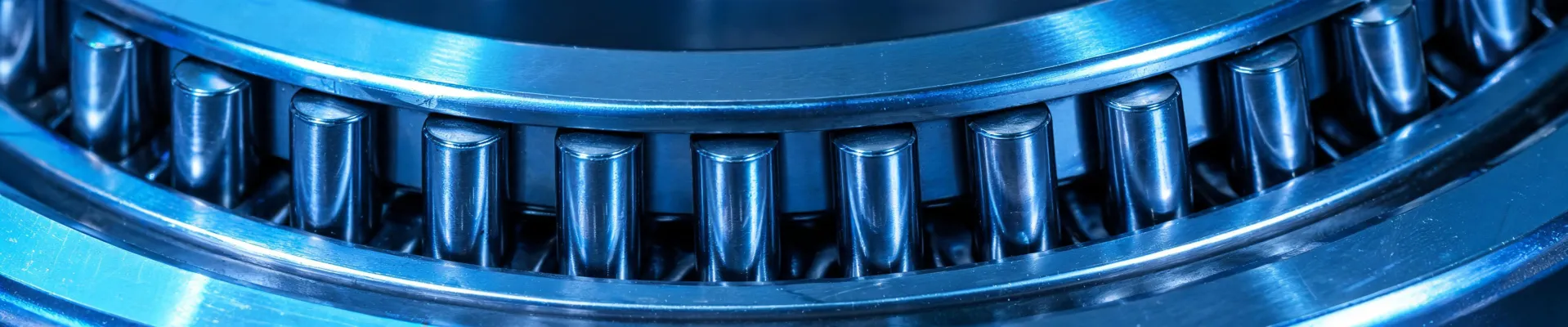
We disassembled the support housing and found the real problem: a needle bearing had failed. The cage had broken, a few rollers had shifted, and the bearing had started running on the shaft itself. That allowed the ball screw to move axially by almost half a millimeter. Under load, the ball nut was hammering against one side of its raceway with every stroke.
For a moment, I thought we'd need to replace the whole actuator. That would have been a four week lead time from the OEM. Then I checked the ball screw itself. We set it up on V-blocks and ran a dial indicator along the thread. The screw was straight. The raceways were still clean. The damage was limited to the support bearing, the seal, and the contaminated grease.
The actuator wasn't dead. It just needed the right bearings.
The ball screw repair decision
Here's where the pressure started. We had a customer order scheduled for Thursday afternoon, and the loading line was the only one in the building that could run that carton size.
The OEM's service engineer offered two options. The first was a complete replacement actuator, but it wouldn't ship for at least eight business days because of the holiday backlog. The second was to pull the ball screw assembly and send it to their reconditioning shop for what they called a ball screw repair. That service would include cleaning, inspection, new balls if needed, and replacement of the support bearings. Best case turnaround was five working days, plus shipping time, plus no guarantee that it would be ready before our deadline.
I've been in maintenance long enough to know that a five day estimate from a busy repair shop usually means seven.
So I asked a different question: could we get the original support bearing locally and do the repair ourselves?
The answer was no from three local suppliers. They all had generic equivalents in stock, but none of them had the exact INA bearing listed in the actuator's parts manual. One counter guy told me, quote, this will probably work, but you'll have to check the fit yourself, unquote. I didn't want to do that with a Thursday deadline.
Using the INA bearings website and catalog
By Wednesday afternoon, I was on the INA bearings website from my phone in the maintenance office. The bearing designation was stamped on the old housing ring, and when I typed it into the search field, the product page came up immediately. The INA bearings catalog is public online, which is something I don't think enough maintenance people realize. You don't have to call a distributor and wait for them to read you a cross reference. You can look up the drawing, the seal type, the load ratings, and the exact dimensions yourself.
There were two similar bearing variants in that width. One was open and one was sealed. The original actuator used the sealed version, and the catalog confirmed why: the open version required a lubrication line that this little actuator didn't have. If I'd taken the generic part the local supplier offered, it would have failed again within a few months, probably faster.
I also noticed something in the catalog data that made me more confident about the decision. The dynamic load rating of the original INA bearing was higher than the generic alternative, even though the dimensions were identical. That's the kind of detail you can't see by holding two parts side by side. You have to look at the engineering data.
An authorized distributor two hours away had two of the sealed bearings in stock. The counter guy said he could put them on the afternoon truck for delivery the next morning, but that truck was ground freight. Ground freight in our area means it might arrive by ten, or it might arrive by four. It's an estimate, not a time.
Then he offered an overnight option. It cost about a hundred and four dollars more, and it came with a guarantee: delivery by ten thirty the next morning or the freight charge was refunded.
I paid the hundred and four dollars without asking my manager. That was the easiest decision I made all week.
What the extra money actually bought
The bearings arrived at 9:52 the next morning. I signed for them, walked them up to the line, and we had the actuator reassembled by lunch. After a few test cycles, the current on the drive was back to normal. We cleaned the area, replaced the grease, and ran the line through the night. The Thursday customer order shipped on time.
Some people would say I overpaid for freight that day. A hundred and four dollars is a lot for a small box of bearings that probably weighed less than a kilogram. But I wasn't paying for the box. I was paying for the difference between probably and guaranteed.
If that box had shown up Friday afternoon, we would have missed the customer's loading window, paid overtime for a weekend catch up run, and had to explain to the plant manager why a badly quoted ground shipment cost us a full production day. The hundred and four dollars started looking pretty small next to that.
It took me a long time to understand this. Early in my career, I would have taken the cheaper freight and hoped for the best. But I learned the hard way that hope is not a reliability strategy. When a machine is down, an estimated delivery date is just a guess with a label on it. A guaranteed delivery date is something you can plan around.
The other lesson is simpler: look up the bearing before you need it. If I hadn't known the INA bearing designation, and if I hadn't checked the INA bearings catalog to confirm the sealed variant, I would have walked out of that local supplier with the wrong part. The actuator would have run for a while, maybe even for a few weeks, and then it would have failed again, probably at a worse moment.
Now I keep a few things on my phone. I have the plant's critical bearing list. I have bookmarks for the INA bearings website and the local authorized distributor. And I have a simple rule for emergency repairs: if a part has to be there by a certain date, don't buy a maybe. Buy a guarantee.
That tiny linear actuator taught me more about supply chain than any training class ever did.

Elena Markovic
Elena Markovic is an independent industrial motor and drive systems analyst covering induction motors, servo motors, stepper motors, and variable-frequency drives. She examines IEC 60034-30-1 efficiency classes, IEC 61800-9-2 drive-system losses, speed-torque curves, duty cycles, thermal limits, and feedback compatibility across operating envelopes. Her evidence-led guides help OEM engineers and plant teams select efficient motion packages, plan integration, and reduce commissioning risk.