Most bearing failures are not bearing failures. They are specification failures.
I know that sounds like a supplier excuse. It is not. I have spent more than four years as a quality and compliance reviewer for a precision drive components supplier in Germany, checking the paperwork behind incoming orders and returned products. That means reviewing roughly 400 to 500 unique specification line items a year. A large share of those line items are INA bearings and related transmission components: needle roller bearings, pillow block bearings, guides, actuators, the whole mechanical drive family.
I do not work for INA, by the way. I work with their catalogues and products daily. So this is not me defending a manufacturer. This is me describing what I see from the middle of the transaction.
The reason I push back on the phrase 'bearing failure' is simple. When a component comes back to the warehouse and I compare the original specification with the actual complaint, the component is often technically healthy. It is not cracked. It is not out of tolerance. It was not badly heat-treated. It was specified or installed on the basis of incomplete information. The bearing did exactly what it was built to do. Nobody told it the truth about the application.
Here is my position: if your quality process starts at the final inspection bench, it starts too late. It should start at the order intake—or earlier, when an engineer is still deciding what to ask for.
Needle roller bearings: the shaft is half the bearing
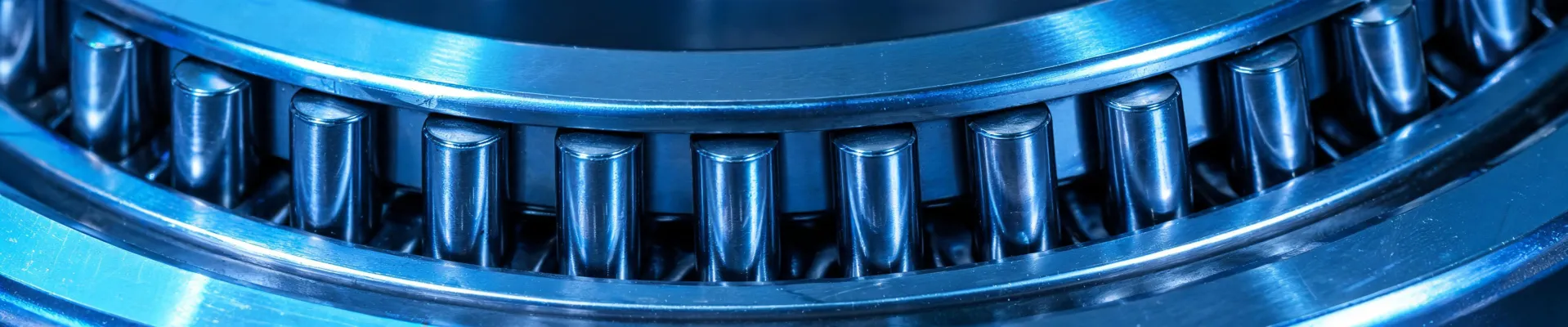
Needle roller bearings are a good place to start because the INA brand has built much of its reputation on them. A needle roller bearing handles high loads in a small radial space. That makes it attractive. But many needle roller bearing designs do not come with an inner ring. The shaft itself becomes the inner raceway. That means the shaft is not just a mechanical support. It is a functional part of the bearing system, with hardness and surface finish requirements.
If an order says 'INA needle roller bearing, part number, quantity', the bearing manufacturer can deliver that. What the manufacturer cannot do is guess whether the shaft has been hardened and ground to the required specification. The load ratings in the catalogue—and the life calculations behind ISO 76 and ISO 281—assume a correctly prepared raceway. For many needle bearing series, the required shaft hardness is somewhere around 60 HRC. A plain turned shaft does not come close. If you run a needle bearing on a soft shaft, you are not applying the bearing according to its rating. You are applying it outside its design envelope and calling the result a failure.
In Q1 2024, I reviewed three returned needle bearing assemblies. All three had noise complaints. All three bearings met drawing tolerance. The applications did not: one shaft was unhardened, one was undersized, and one had a surface finish that belonged on a structural part, not a raceway. The bearings were fine. The specifications were not.
Pillow block bearings: the housing is the easy part
INA pillow block bearing units seem simple. You get a housing, an insert bearing, and a seal. They make mounting straightforward, which is why maintenance teams like them. But the selection still depends on details that rarely make it onto a purchase order.
The insert bearing inside a pillow block unit has to lock onto the shaft. Depending on the unit, that might be a set screw arrangement or an eccentric locking collar. Both depend on shaft diameter tolerance, shaft finish, and proper tightening. A set screw will not fix an undersized shaft. An eccentric collar will not hold if it is tightened in the wrong direction. The housing can be perfect and the bearing can be perfect, and the assembly can still loosen when the shaft is not.
When someone orders a pillow block unit, they usually tell us the shaft diameter. They often do not tell us the shaft tolerance, the locking direction, or the vibration environment. Those are not minor technicalities. They are the difference between a unit that runs for five years and a unit that comes back in five weeks.
Self-aligning ball bearings: alignment is not a cure-all
The self-aligning ball bearing is probably the most misunderstood product name in our catalogue. It has two rows of balls and a common spherical raceway in the outer ring, which allows the bearing to compensate for angular misalignment between the shaft and the housing. That is a genuine advantage. Shaft deflection and housing machining errors happen.
But 'self-aligning' does not mean 'self-correcting for every mistake'. A self aligning ball bearing compensates for angular misalignment. It does not correct an undersized shaft, a poorly machined housing bore, or the wrong load direction. In most designs, the axial load capacity is moderate, so a predominantly axial load points toward a different bearing arrangement.
I have lost count of the orders that simply say 'self aligning ball bearing' and stop there. No speed. No misalignment estimate. No load direction. The bearing gets blamed later when the application was never fully described in the first place.
Electric linear actuators and a VFD question
Electric linear actuators deserve the same respect for specifications. An electric linear actuator converts motor rotation into straight-line motion through a lead screw or ball screw. It is a compact package, but it is still a system: motor, screw, guidance, limit switches, sometimes a brake.
Customers often tell us the required force and stroke. Those are the easy numbers. The harder number is duty cycle. An actuator can deliver a high peak force for a short time, but that does not mean it can hold that force continuously without overheating. If the order says '8000 N actuator' and never mentions how often or how long it runs, the selection is incomplete. The actuator is not failing. It is working until the thermal limit that nobody specified.
There is also the acronym question that shows up in search logs: what VFD stands for. VFD stands for variable frequency drive. It is a motor controller that changes the frequency and voltage supplied to an AC motor to control speed and torque. On the surface, that has nothing to do with a bearing catalogue. Underneath, it often does.
VFDs create high-frequency switching voltages. Depending on motor frame size, grounding, cable length, and drive settings, those voltages can couple through the motor and discharge through the rolling bearings. The result can be electrical pitting or fluting on the raceway. The bearing looks damaged, but the real cause is the electrical environment. Standards such as NEMA MG 1 and IEC 60034-25 discuss these risks for inverter-fed motors. The right mitigation might be an insulated bearing, a hybrid bearing, or a shaft grounding solution—but nobody can choose that if the order never mentions the VFD.
I remember a 2023 return where the customer described the issue as 'the electric linear actuator failed'. The mechanical parts were fine. The motor bearings showed classic signs of electrical discharge. The order had specified a fixed-speed application with no VFD. The installed machine had a VFD added later. The actuator did not fail. The application changed, and the specification did not change with it.
No, I am not claiming every failure is a specification failure
To be fair, genuine manufacturing defects exist. I have rejected deliveries where measurement results were visibly outside the allowed tolerance. No bearing manufacturer is perfect, and I do not expect them to be. The difference is that a real quality problem is rare, while a specification gap is almost routine.
I understand the objection: a busy engineer does not want a ten-minute conversation about duty cycle and shaft hardness. They want a part shipped tomorrow. That is fair. But if you want the part to behave as expected, the operating conditions have to be written down somewhere. Otherwise the supplier is guessing, and the machine pays for it.
I would rather spend ten minutes explaining options than deal with mismatched expectations later.
An informed customer asks better questions and makes faster decisions. They are not a threat to a supplier. They are the best kind of customer, because their projects do not fail from something that could have been caught on a single page of specifications.
So the next time a bearing fails, ask one question before you blame the bearing: did the specification tell the truth about the application?

Elena Markovic
Elena Markovic is an independent industrial motor and drive systems analyst covering induction motors, servo motors, stepper motors, and variable-frequency drives. She examines IEC 60034-30-1 efficiency classes, IEC 61800-9-2 drive-system losses, speed-torque curves, duty cycles, thermal limits, and feedback compatibility across operating envelopes. Her evidence-led guides help OEM engineers and plant teams select efficient motion packages, plan integration, and reduce commissioning risk.