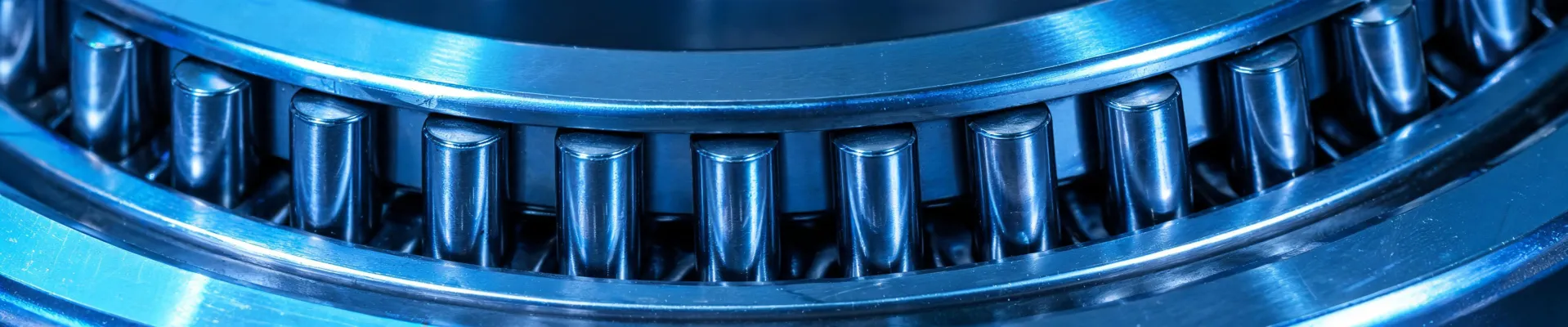
It started with a returned unit in our Q1 2024 quality audit. The customer had seen the same thing we did: a noisy linear axis, erratic repeatability, and one ball bearing race that came back blued and flaking. The work order said INA bearings—that part was right. But it also said “standard ball bearings,” and that part was the beginning of the mistake.
I'm not a bearing designer, and I won't pretend to be one. I review quality for a small automation manufacturer—about 200 unique assemblies a year, with roughly 50,000 units out in service. My job is to catch issues before they leave the building. This one got out anyway.
The Problem That Looked Too Simple
From the outside, the fix looked obvious: swap the bearings and send it back. The noise was coming from a worn set of deep-groove ball bearings on the shaft. But when I sat down with the application notes, the real story surfaced. It's tempting to think a ball bearing is a ball bearing. In truth, load direction changes everything.
The assembly had a radial ball bearing installed on an axis that was carrying mostly thrust—axial load along the shaft. A radial ball bearing can support some axial load, but it's designed to run with the load pointing straight into the bore, perpendicular to the shaft. Push it hard along the shaft's centerline and the balls slide instead of rolling. The raceways overheat, the retainer gets stressed, and the bearing fails what looks like a normal life test.
People assume a bearing that rotates smoothly on the bench will rotate smoothly under load. What they don't see is the force direction hidden inside the housing.
We had hit the classic oversimplification: “INA bearings are good bearings, so any INA bearing must solve it.” Nope. The bearing type had to match the load case.
Where INA Thrust Bearings Came In
For a shaft with a heavy axial push, we should have specified an INA thrust bearing. There are several families—AXK needle thrust bearings, 812 cylindrical roller thrust bearings, or a thrust ball bearing, depending on speed and load. Those parts are built to carry axial force directly, with raceways and rolling elements arranged to accept that direction without sliding.
That field failure didn't need a cutting-edge exotic part. It needed the right INA thrust bearing, mounted properly, and the radial bearing left to do what it does best: locate the shaft radially.
I'd read all of this before. I only believed it after seeing a $14,000 redo land on our lap.
The Linear Motion Angle
The harder part of the return was the second axis—the one moving back and forth for positioning. The original spec called for a shaft and bushing assembly. The bushing was fine in the catalog, but it wasn't fine for the customer's speeds.
When you need smooth, precise linear travel, there's a family of INA linear roller bearings and mounted linear bearings that do a different job than rotating shaft bearings. A linear guide or a mounted linear bearing gives you rolling elements on a raceway—often a rail—that keep the carriage tracking straight. It's not the same rotation, so geometry, preload, and sealing are all different.
Our mistake was mixing concepts: we built an axis with a plain bushing and expected it to behave like a precision linear guide. No bearing, no matter how good the brand, can fix a system designed with the wrong friction pair.
A Part About How Ball Bearings Are Made
After that project, I made a point to visit a bearing manufacturing site—partly to verify our suppliers, partly out of curiosity. Watching how ball bearings are made changed how I audit quality.
It goes: steel wire is cut into slugs, cold-headed into rough spheres, heat treated, then hardened and ground. The grinding makes the balls round. Then comes lapping or superfinishing, which brings the surface to a mirror finish measured in nanometers. In the last step, matching machines measure every ball in a batch and pair them with others that are very close in size, then the whole set is placed into the raceways.
A single skipped superfinishing pass doesn't make the bearing look different or feel different on day one. It shows up later as noise, vibration, or early fatigue. The same is true for steel chemistry, the heat-treat profile, and the cleanliness of the assembly area. This is why an engineering-quality product like INA has a reputation—process discipline shows up in failure statistics, even when it isn't visible from the outside.
According to ISO 281, the basic rating life L10 is defined as the life that a group of apparently identical bearings can be expected to reach or exceed with 90% reliability. That reliability is built upstream, in the manufacturing process, not in the box.
What We Changed
First, we wrote a simple internal checklist for every motion axis:
- Identify the direction of the main load: radial, axial, or combined.
- Calculate the equivalent dynamic load before picking a bearing family.
- Use radial ball bearings only for radial-dominant loading.
- Use INA thrust bearings for axial-dominant loading.
- For precise linear travel, choose INA linear roller bearings or mounted linear bearings—not a plain bushing.
That list looks embarrassingly basic, and maybe it is. But it came from a real failure, so the team actually follows it.
We also standardized how we write bearing specifications on drawings. Instead of “INA bearings or equivalent,” we now write the exact family, size, and clearances. That “or equivalent” phrase was a trap. Several of our early failures happened because someone interpreted “equivalent” as “a radial ball bearing with the same bore size.” Same bore, but completely different load capability.
The Perception Side
Here's the part that stuck with me: the customer who returned the unit didn't blame the bearing. They blamed the machine. I'm not a salesperson, so I can't speak to all the pricing strategies, but from a quality perspective, the link was pretty direct.
A machine that rattles or loses position feels cheap. It doesn't matter if every other component is made to aerospace tolerance. The bearing decision shaped the customer's whole perception of our equipment. I've seen this twice in four years, and it never gets easier.
That's the quality perception lesson. It isn't about buying the most premium option on the shelf. For the right load case, an INA thrust bearing or a linear roller bearing is correct—and the reason I'd do it again isn't brand loyalty. It's that the failure mode, the load direction, and the product design all pointed the same way.
Kinda embarrassing to admit we got it wrong to begin with. But a lot of engineering is learning the hard way.

Elena Markovic
Elena Markovic is an independent industrial motor and drive systems analyst covering induction motors, servo motors, stepper motors, and variable-frequency drives. She examines IEC 60034-30-1 efficiency classes, IEC 61800-9-2 drive-system losses, speed-torque curves, duty cycles, thermal limits, and feedback compatibility across operating envelopes. Her evidence-led guides help OEM engineers and plant teams select efficient motion packages, plan integration, and reduce commissioning risk.