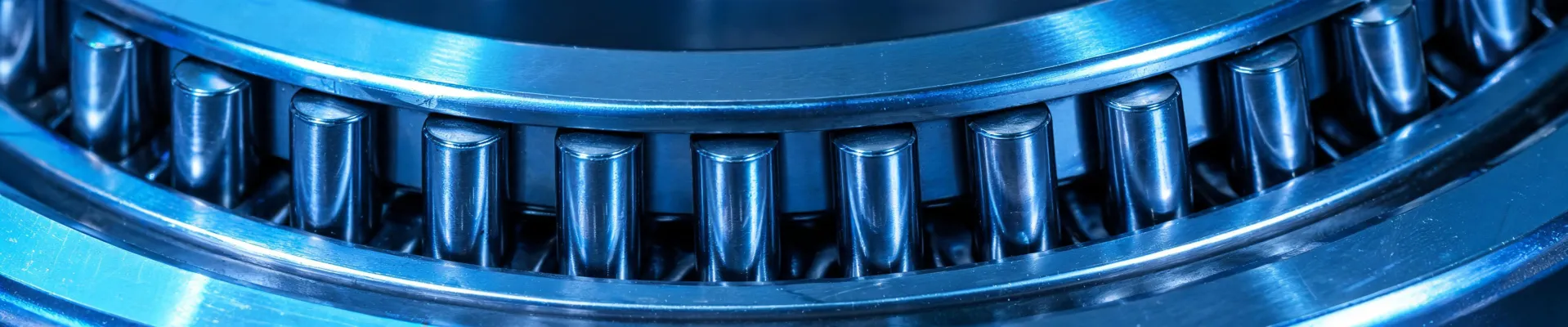
I'm a mechanical engineer who's been specifying bearings for industrial equipment for eight years. In that time, I've personally made twelve significant mistakes — things that cost roughly $18,000 in wasted budget and way more in lost credibility. One of the most common? Picking the wrong bearing type. Specifically, assuming roller bearings and ball bearings are interchangeable. They're not. And that assumption cost me a $3,200 order in January 2022.
So let's settle this once and for all: when should you use a roller bearing, and when should you go with a ball bearing? I'll walk you through the three dimensions that matter most, based on the scars I've collected.
The Comparison Framework
We're comparing two broad categories: roller bearings (like INA's cylindrical, spherical, and needle roller series) and ball bearings (including deep groove, angular contact, and thrust ball bearings). The key dimensions are:
- Load capacity & direction
- Speed capability
- Installation & alignment tolerance
Every dimension gets a direct side-by-side — no waffling, just what I've seen work (and fail) in the field.
Dimension 1: Load Capacity & Direction
From the outside, both roller and ball bearings look like they handle loads. The reality is they're built for completely different stress profiles.
Roller bearings use line contact — a cylinder (or tapered cylinder) rolling against a raceway. That line contact spreads the load over a larger area, so roller bearings can handle 2–3 times the radial load of a similarly sized ball bearing. According to Schaeffler's technical handbook (the parent company of INA), a cylindrical roller bearing of the same bore size as a deep groove ball bearing can support roughly 2.5× the static radial load rating. That's not marketing — that's geometry.
Ball bearings, on the other hand, rely on point contact. That means they're better at handling combined loads (radial + axial simultaneously) and are naturally suited for higher speeds. But push too much radial load on a ball bearing and you'll see the raceway brinelling — permanent dents that feel like a gravel road when the shaft rotates.
People assume ball bearings are cheaper and lighter, so they must be the better all-around choice. What they don't see is that using a ball bearing where a roller is needed leads to premature failure. I made this mistake on a conveyor drive: I spec'd a 6206 ball bearing because it was $18 cheaper. That bearing failed in 11 months. The replacement (an NU206 cylindrical roller bearing) is still running after 3 years.
Dimension 2: Speed Capability
Here's where the conventional wisdom flips. Most engineers think roller bearings are rugged, so they must be able to spin fast. Actually, it's the opposite. Ball bearings generally have higher speed limits because the friction from point contact is lower than line contact.
For a given bore size, a deep groove ball bearing can run at 1.5–2× the RPM of a cylindrical roller bearing — sometimes more depending on cage design and lubrication. INA's catalog shows a 6308 ball bearing has a limiting speed of around 9,000 RPM (grease, open), while an NU308 cylindrical roller bearing is capped around 5,500 RPM under identical conditions.
I learned never to assume a roller bearing can handle the same speed just because it's physically larger. The assumption failure happened on a pump application in 2023: I swapped a ball bearing for a roller bearing thinking it'd be more durable. The roller bearing screamed past its limiting speed, the cage distorted, and the pump seized. $4,200 damage and a week of downtime.
Granted, there are specialized high-speed roller bearings (like certain needle roller designs). But for general industrial applications, if your shaft runs over 3,000 RPM, I'd start with a ball bearing and only switch to a roller if load calculations demand it.
Dimension 3: Installation & Alignment Tolerance
Ball bearings are pretty forgiving with misalignment — especially deep groove types. You can be off by a few degrees and they'll still spin, albeit with reduced life. Roller bearings? Not so much.
Cylindrical roller bearings are sensitive to axial misalignment. Even 0.001 inch of misalignment can cause uneven load distribution, leading to edge loading and spalling. Spherical roller bearings tolerate moderate misalignment (up to 2 degrees depending on series), but they're bulkier and more expensive.
I went back and forth between a spherical roller bearing and a pair of angular contact ball bearings for a mixer shaft. The spherical option handled the heavy loads better, but the shaft alignment wasn't perfect — and I didn't have the budget for precision machining. Ultimately, I chose two ball bearings in a back-to-back arrangement because they'd tolerate the misalignment without catastrophic failure. That decision saved my project timeline, even though the load margin was tighter.
To be fair, if you can guarantee precise alignment (laser-aligned mounts, ground housings), a roller bearing will outperform the ball bearing on load capacity. But in the real world, alignment isn't perfect. Factor that into your choice.
What About Thrust Bearings? (A Quick Detour)
One of your keywords is "what's a thrust bearing". Simple answer: a thrust bearing handles pure axial (thrust) loads — like the force from a propeller shaft or a lead screw. They come in both ball (thrust ball bearings) and roller (cylindrical thrust roller, tapered thrust, etc.) designs. The same trade-offs apply: ball thrust bearings handle higher speeds but lower loads; roller thrust bearings handle higher loads but lower speeds. I've personally overspecced a thrust ball bearing before — assumed axial loads were small, didn't calculate properly. $750 wasted because I didn't read the catalog's load-speed curve.
Scenario-Based Choice Guide
Here's where I've landed after all the mistakes:
- High radial load, low-to-medium speed, good alignment → Go with a roller bearing (INA cylindrical or spherical series). Example: heavy conveyor, press roll, gearbox input shaft.
- High speed, moderate loads, some misalignment → Stick with ball bearings (deep groove or angular contact). Example: electric motor, pump, fan.
- Combined radial + axial loads at moderate speeds → Angular contact ball bearings or tapered roller bearings. The choice depends on whether axial load is dominant (tapered) or balanced (angular contact).
- Pure axial load, high speed → Thrust ball bearing. Pure axial load, high load → Thrust roller bearing (cylindrical or spherical).
- Space-constrained, low load → Needle roller bearing (they save radial space but don't handle misalignment well).
The vendor who said "this isn't our strength — here's who does it better" earned my trust for everything else. INA is excellent in roller bearings and ball bearings across a lot of applications. But if your application is ultra-high speed (over 10,000 RPM) or requires non-standard precision, you might need to look elsewhere. That's not weakness — it's expertise knowing its boundaries.
Don't assume you can swap one for the other. Don't assume the cheaper option is the smarter choice. And please, don't repeat my $18,000 of lessons. Start with the load and speed requirements, check the alignment, and pick the bearing type that fits — not the one that's easiest to find in stock.

Elena Markovic
Elena Markovic is an independent industrial motor and drive systems analyst covering induction motors, servo motors, stepper motors, and variable-frequency drives. She examines IEC 60034-30-1 efficiency classes, IEC 61800-9-2 drive-system losses, speed-torque curves, duty cycles, thermal limits, and feedback compatibility across operating envelopes. Her evidence-led guides help OEM engineers and plant teams select efficient motion packages, plan integration, and reduce commissioning risk.